Файл:Terrestrial planet size comparisons.jpg

Ҡыҫҡа аңлатма
| Тасуирлау |
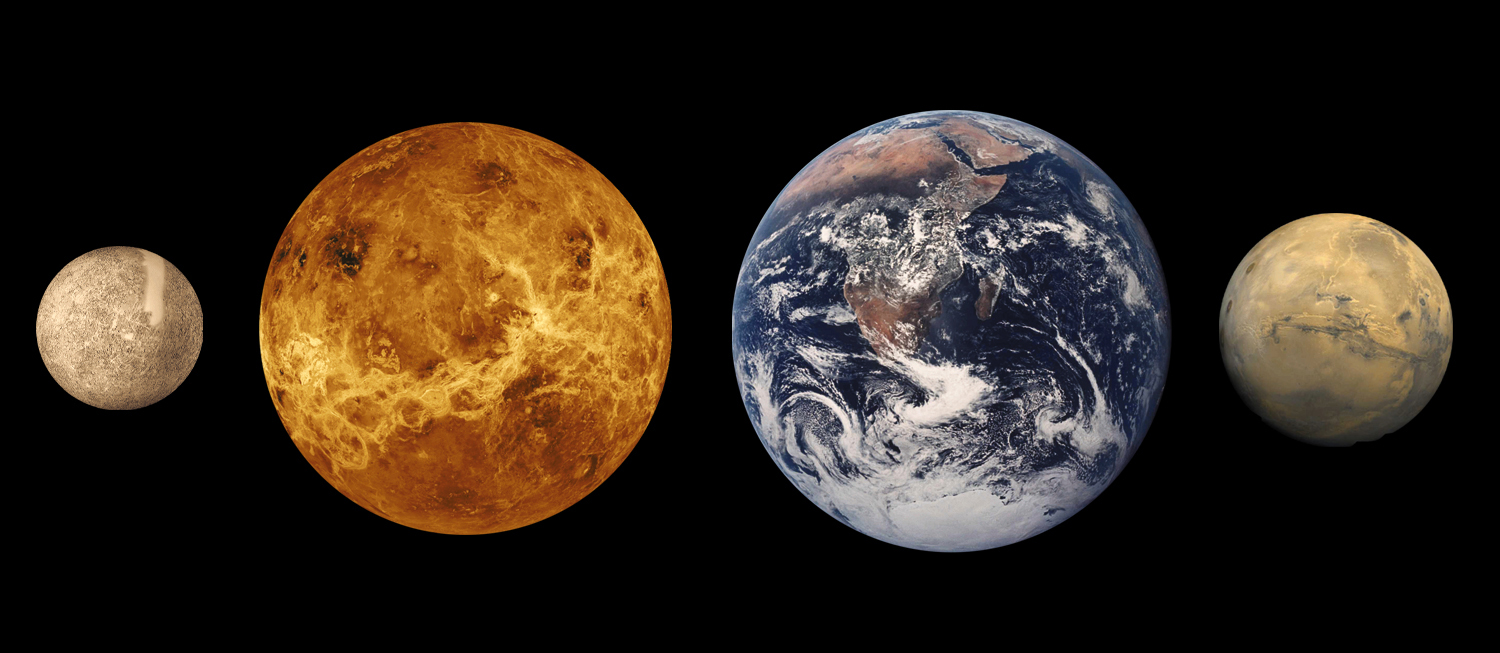
Deutsch: Diese Darstellung zeigt die ungefähren relativen Größen der erdähnlichen Planeten, von links nach rechts: Merkur, Venus, Erde und Mars. Die gezeigten Abstände sind hingegen nicht maßstabsgerecht.
Ein erdähnlicher Planet ist ein Planet, der hauptsächlich aus Silikatgestein besteht. Solche Planeten unterscheiden sich wesentlich von Gasriesen. Letztere haben nicht unbedingt eine feste Oberfläche und bestehen hauptsächlich aus einer Mischung von Wasserstoff, Helium und Wasser in verschiedenen physikalischen Zuständen. Erdähnliche Planeten haben alle ungefähr dieselbe Struktur: einen metallenen Kern, größtenteils aus Eisen, darum ein Silikatmantel. Erdähnliche Planeten haben Schluchten, Krater, Berge, ggf. Vulkane und eine Atmosphäre.
English: This diagram shows the approximate relative sizes of the terrestrial planets, from left to right: Mercury, Venus, Earth and Mars. Distances are not to scale.
A terrestrial planet is a planet that is primarily composed of silicate rocks. The term is derived from the Latin word for Earth, "Terra", so an alternate definition would be that these are planets which are, in some notable fashion, "Earth-like". Terrestrial planets are substantially different from gas giants, which might not have solid surfaces and are composed mostly of some combination of hydrogen, helium, and water existing in various physical states. Terrestrial planets all have roughly the same structure: a central metallic core, mostly iron, with a surrounding silicate mantle. Terrestrial planets have canyons, craters, mountains, volcanoes and secondary atmospheres. Français : Les planètes telluriques, de gauche à droite : Mercure, Vénus, Terre, et Mars.
Italiano: Questo diagramma mostra approssimativamente le dimensioni relative dei pianeti terrestri, da sinistra a destra: Mercurio, Venere, Terra e Marte. Le distanze non sono in scala.
Un pianeta terrestre è un pianeta composto per lo più di roccia e metalli. Il termine deriva direttamente dal nome del nostro pianeta (anche in latino), "Terra", quindi una definizione alternativa sarebbe che questi pianeti sonoin qualche modo simili alla Terra. I pianeti terrestri sono sostanzialmente diversi dai giganti gassosi, che potrebbero non avere una superficie solida e sono composti soprattutto di qualche combinazione di idrogeno, elio e acqua presenti in vari stati fisici. I pianeti terrestri hanno tutti più o meno la stessa struttura: un nucleo metallico, soprattutto ferroso, circondato da un mantello di silicato. I pianeti terrestri hanno canyon, crateri, montagne, vulcani e atmosfere secondarie. Русский: Планеты земной группы, слева направо: Меркурий, Венера, Земля, Марс. |
|||||
| Көнө | ||||||
| Сығанаҡ |
http://solarsystem.nasa.gov/multimedia/gallery/terr_sizes.jpg Uploaded to commons from the english wikipedia; description page was here
Also previously uploaded as Image:Terr sizes.jpg
|
|||||
| Автор | wikipedia user Brian0918 | |||||
| Рөхсәт (Был файлды ҡабатлап ҡулланыу) |
|
|||||
| Башҡа өлгөләр |
Derivative works of this file: |




Файл тарихы
Файлдың күрһәтелгән ваҡытта ниндәй өлгөлә булғанын ҡарар өсөн баҫығыҙ: Дата/ваҡыт
| Дата/ваҡыт | Миниатюра | Үлсәмдәре | Ҡатнашыусы | Иҫкәрмә | |
|---|---|---|---|---|---|
| ағымдағы | 21:39, 4 декабрь 2018 | | 1500 × 653 (314 КБ) | wikimediacommons>Allice Hunter | Correcting Mars |
Файл ҡулланыу
Был файлды киләһе бит ҡуллана:
